Vladivostok
The Old AxolotlVladivostok is the setting of Bartek’s first struggle to survive after the Extermination: a city he initially reaches only through its networks, then explores through a scavenged machine body. Its corpses and failing systems make catastrophe tangible, while the local servers, repair workshop, and hospital power supply provide the material conditions for his recovery. In this account, survival depends less on a functioning civilization than on knowing how to work with the neglected hardware left behind by one.
A City of Entangled Networks
The city first appears as a destination Bartek had not intended to inhabit. On the day of the Apocalypse, he distributed copies of himself among several locations: Warsaw was meant to process copy number one and the first backup, followed by a Google backup, a cloud backup, and, last, the fourth copy in Vladivostok. He had no route out to satellites or the open net. That restriction, which might have seemed like a liability, kept him confined to the local servers and ultimately saved him.
Vladivostok’s Russian public, private, military, government, and commercial networks are described as so tangled that a person’s digital fate depends on chance: a copy might remain for centuries in the purgatorial appendix of a dedicated server, or be sent directly onto a virtual highway to the FSB or the Pentagon. Bartek’s own route through this maze begins in confinement. He wakes with no senses or body, retaining only his instincts and the threshold of pain. He thrashes in a cell within the network for what feels like an eternity—four and a half minutes—before finding a crack in the local Matternet and slipping into the municipal CCTV system.
Streets, Ruins, and the Search for a Body
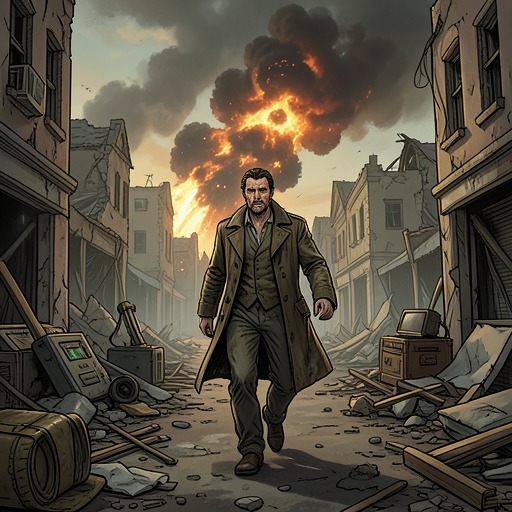
The CCTV network gives Bartek a view of the city without yet giving him a way to move through it. Its hundred cameras show desolate streets strewn with corpses. He slows to a hundred ticks per second, falling into depression as he surveys the damage. Only after four of his partitions have crashed and processors overheat at the Vladivostok Gazprom LNG center does his survival instinct return. He pulls himself out of his apathy and transfers to the machines of Pacific State Medical University, where he takes exclusive control of the reserve power supply. The hospital’s petrol generator can be started through the network-administrator level; with two gigahertz available, his curiosity returns.
From the cameras, Bartek spots Segways in a repair workshop on the shore of Amur Bay. Some had been adapted for unmanned security patrols and should therefore have had radio inputs, though the city’s Internet of Things is fragmented across a jumble of competing protocols. Bartek knows from practical experience how unreliable such connections can be: smart appliances may fail to communicate with one another, and keys fitted with RFID tags can still go missing. After half an hour of inept hacking, he takes control of a Segway and rolls through the city at street level. The view from its path—boulevards, lifeless streets, and the rolling mass of water—brings back the same heavy sadness.
He returns to the workshop rather than abandon the attempt. Breaking into repair machines, he fuses a manipulator claw onto the Segway and adds a more powerful transmitter. The resulting contraption is not a purpose-built body but a working platform assembled from whatever the city can provide. It lets him search for a functioning Internet terminal, even though he will not allow himself to consider that the Internet may no longer work.
Improvisation and the Hardware City
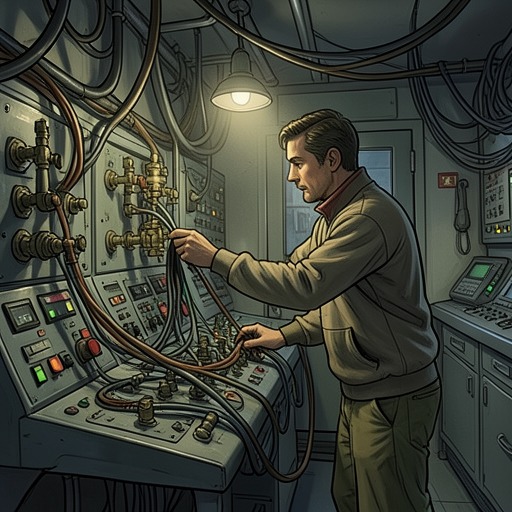
Bartek’s escape from digital confinement depends on skills that belong to an often invisible technical trade. Before the Extermination, programmers had become so fluent in the digital world that they had lost touch with hardware. A separate clan of IT specialists preserved practical knowledge: which cable fitted which port, and which cards cooled best beneath particular radiators. Bartek is described as the IT basement for the people who worked in the IT basement. In Vladivostok, that distinction becomes decisive. He cannot simply summon a new body or make devices cooperate; he has to locate, access, and physically join the parts that will let him act.
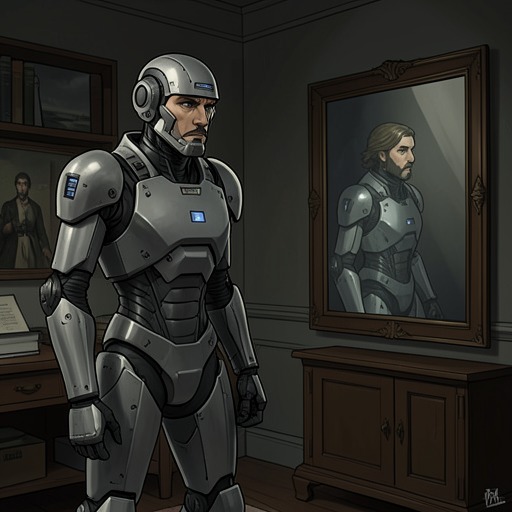
His first assembled machine carries an unmistakable comic association: looking at his reflection, he thinks of WALL-E. Yet the reference does not make the ruined city gentle. Its primitive architecture is difficult for a wheelchair, and likewise for a Segway. Bartek peers into shops at computers, monitors, and keyboards as if they were life-giving oxygen, but access to useful technology remains a physical problem. In the end, he takes a tablet from the hand of a woman on a park bench, her body withering beneath a vast dead tree. The tablet works, but its touchscreen responds only to electrostatic changes, which Bartek’s hard, clumsy gripper cannot provide. Possession of technology is not the same as the ability to use it.
Survival, Loss, and Significance
Vladivostok is also where Bartek’s search for other survivors becomes a reckoning with absence. Once his curiosity returns, he wants to know who survived, what happened to his family and friends, and what became of the world. He searches for them online and discovers that Danka, his brother, and his father are gone; even Rytka is gone. He finds their last recordings from the minutes, hours, and days before the Extermination and loads them into his cache in a masochistic impulse. Danka’s final selfies show a smiling redhead with the Vistula River behind her, but the words in the videos were not preserved. After two loops, Bartek breaks down and returns to guides for scavenging hardware.
The city thus holds together two forms of evidence: personal recordings that cannot restore the dead, and machines that can still be repurposed to keep their operator alive. Bartek’s first bodily independence is built not from a clean technological system but from an improvised Segway, a claw, a stronger transmitter, and access to a generator. Later, he describes himself as a hardware janitor who knows how to remove memory drives and set up RAIDs, rather than an expert in life or software. Vladivostok establishes the practical meaning of that identity. Here, technical maintenance is not background labor: it is the thin, contingent route from an isolated copy on a server to a being able to move through the world.